
Deep Dive: The US Dollar
The US dollar has weakened meaningfully over the past year, hitting a four-year low in January. This has fueled a wave of ominous narratives: “Sell America Is the New Trade on Wall Street,” “Dollar Fears Are Flaring as Trump Rekindles Debasement Trade,” “The Age of a Treacherous Falling Dollar,” and “The Reign of the Dollar Is Coming to an End,” to name a few. To help readers cut through the noise and ground the conversation in fundamental analysis, we dedicate this quarter’s Deep Dive to the US Dollar: what we know, what we don’t know, and what it means for investors.
Building Blocks: What Drives the Value of a Currency?
A currency’s value is shaped by numerous interrelated forces, including macroeconomic fundamentals, political stability, and investor sentiment. It can be helpful to think of currency value as a function of supply and demand - just like any other good or service. The key factors that drive the supply and demand of a currency include:
Monetary policy and interest-rate differentials: Capital flows to where risk-adjusted returns are most attractive. Higher relative interest rate expectations support a stronger currency; lower rate expectations do the opposite.
Economic growth differentials: Faster growth attracts capital, increasing demand for the currency. Sluggish growth relative to peers pushes investors elsewhere.
Inflation expectations: Persistent inflation erodes purchasing power and undermines confidence in the currency’s long-term value, especially when inflation is higher than other countries and export competitiveness suffers.
Fiscal trajectory and debt issuance: Large deficits increase the supply of government debt that must be absorbed by investors, which can raise concerns about fiscal sustainability.
Investor risk sentiment: In times of global fear, investors seek liquidity and safety. Historically, the US Dollar has benefited from this dynamic given its safe-haven reputation, strong military, and the unparalleled depth and liquidity of US financial markets. In more speculative periods, investors often seek higher potential returns in riskier assets and higher yielding markets, which lowers demand for the dollar.
Trade dynamics: Trade deficits, where imports exceed exports, increase the supply of a currency globally, putting downward pressure on its value. Trade surpluses do the opposite.
Institutional credibility: Central bank independence, rule of law, and policy consistency matter a great deal. Investors want to be assured that their assets won’t be undermined by sudden regime change, corruption, or erratic policy shifts. History is replete with examples where political interference in monetary policy contributed to runaway inflation and currency collapses.
Reserve currency status: the US dollar is the world’s dominant reserve and transaction currency, creating ongoing structural demand. While its share has declined somewhat, no clear rival has yet emerged to credibly challenge its primacy.
Where We Are Today - Putting Things in Context
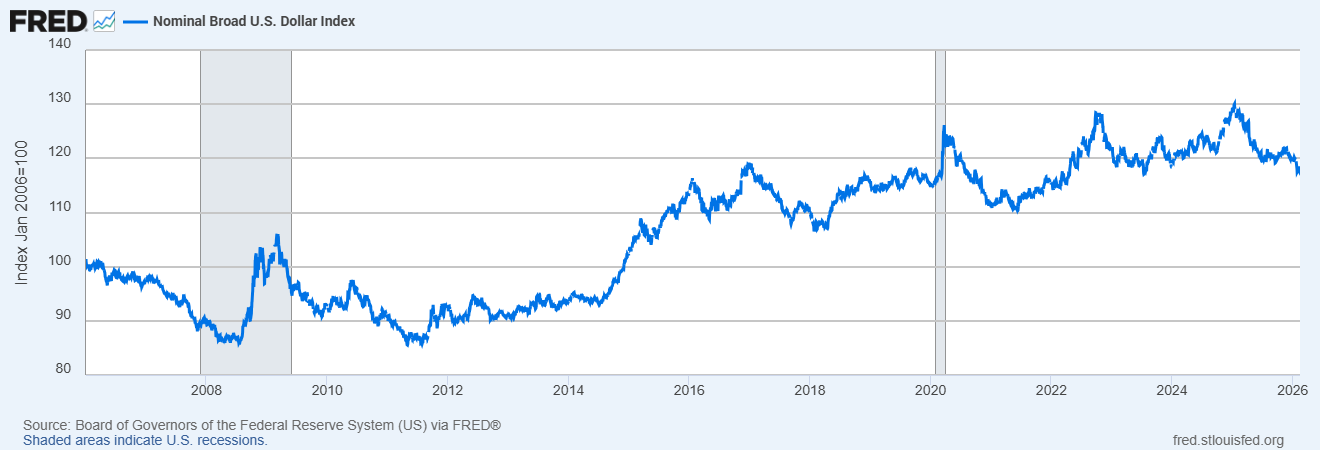
The recent decline in the US dollar has been noticeable enough to matter, particularly for international businesses. However, just one year ago, it reached a multi-decade high, and today’s levels are roughly in line with pre-COVID highs. While a trend reversal is possible, we view this as a pullback within a longer-term dollar bull market, similar to what we saw in 2017, 2020-21, and 2022-23.
Why did the US Dollar Drop in Value?
It is impossible to say with certainty why the dollar has weakened. However, by considering meaningful changes to some of the aforementioned drivers of currency value, a few things stand out. Notably, uncertainty over monetary policy is elevated on account of the coming leadership change at the Federal Reserve. The transition is accompanied by an assumption among many that future Fed policy will tilt toward lower rates. Another more recent phenomenon has been the risk-on appetite for global assets. In 2025, international markets outperformed the US as capital flowed into overseas investments.
Deficit spending, elevated public debt, inflation dynamics, large trade imbalances, and the erosion of the US Dollar as the world’s reserve currency are long-term trends that put downward pressure on the dollar. In the near term, however, these can be offset by higher US economic growth and persistent foreign demand for US assets, including stocks, bonds, and real estate. We have seen many articles that focus on one or two of the more frightening-sounding themes, but these trends have been in place for years, including during periods when the dollar strengthened. Given the absence of substantial changes to these forces over the past year, we doubt they’re playing a significant role in the dollar’s recent decline.
Our US Dollar Forecast
Our base case is for the dollar to be range-bound with a mild downward bias in the coming quarters. The Fed transition could bring volatility as markets recalibrate expectations. We expect the new Fed leadership to gradually lower the benchmark interest rate while maintaining institutional independence and credibility. If the transition is orderly, it should contain credibility risk even as rate cuts narrow the US interest rate premium – offsetting forces that could keep the dollar near current levels. While we view this as the most likely outcome, there are other plausible pathways that would increase volatility and change our outlook.
What would change our view? A global risk-off episode could strengthen the dollar quickly, as it often does when investors prioritize liquidity and safety. On the other hand, clearer evidence that policy is steering toward materially easier conditions than the market currently expects would increase the odds of further dollar weakness.
What a Weaker Dollar Means for Investors
A softer dollar tends to show up in portfolios in three practical ways. First, it boosts returns from foreign holdings for US based investors when local market gains are translated back into dollars. Second, it can boost the earnings of large US multinationals because foreign revenues translate into more dollars. Third, it can weaken US consumer purchasing power by raising the cost of imports and international travel, which is challenging since inflation is already running above the Fed’s target. A weak dollar often supports commodity-linked industries because many globally traded raw materials are priced in dollars, though supply-demand factors are a larger driver of commodity prices than currency alone.
We do not build portfolios around short-term currency calls, but the dollar’s direction reinforces the benefits of geographic diversification. A sustained period of dollar weakness enhances the value of international assets for US-based investors. It also underscores our preference for investing in businesses with durable pricing power, real earnings growth, and strong balance sheets since currency movements can shift the competitive landscape and the inflation backdrop without warning.