
Economic and Financial Market Outlook Q3 2026
Global Economy: From Shock to Aftershock
Global growth proved resilient through a quarter that began with a war in the Persian Gulf and the largest oil supply disruption in history. Though a final resolution in the War with Iran has proven difficult to secure, worst-case scenarios did not unfold; the price of oil fell substantially from its spring peak, removing a major threat to growth. The key uncertainty now shifts from geopolitical disruption to policy responses aimed at combatting prices that remain too high. That transition defines the tension we see for the second half of the year: rich market valuations and a resilient economy on one side, sticky inflation and tighter policy on the other.
US Economy: Firmer Footing, Thinner Wallets
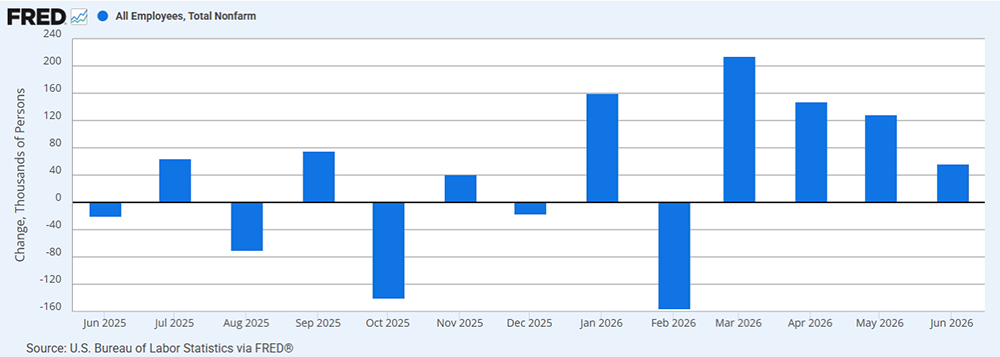
The labor market was a source of concern in our last Outlook and we wrote that we would need to see it improve before growing more optimistic. The recovery arrived, though June’s report tempered its strength. The net job losses that troubled us at the start of the year gave way to solid spring hiring with payrolls rising 178,000 in March. Since then, momentum has faded each month to just 57,000 in June. The unemployment rate ticked down to 4.2%, though the decline owes partly to a 0.3% drop in labor force participation, meaning some of the improvement reflects workers leaving the workforce rather than finding jobs. On balance, the labor market has stabilized rather than rebounded.
Real wage data has emphasized a more cautious read: it turned negative month over month in April, and the decline deepened to -0.7% in May, which means households have lost purchasing power despite healthy job growth. That dynamic has weighed on consumer-facing businesses and sharpened the K-shaped divide we first described in Marietta’s Deep Dive: The US Consumer (11/20/25). This helps to explain why consumer sentiment remains mired near historic lows while aggregate growth is steady but unspectacular. We reiterate our view that US GDP growth will settle around 2.5% in 2026.
Inflation is the swing factor from here, and the current data require careful interpretation. Headline CPI rose to 4.2% in May, up from 3.8% in April and the highest in three years, driven primarily by the energy spike that arose from the Iran conflict. Core inflation, which strips out volatile food and energy costs, points to a more subdued pricing environment. The positive case depends on core inflation remaining contained. If it does, the recent inflation setback will prove short-lived. If it does not, price pressure will have broadened through the economy, raising the likelihood of Federal Reserve rate hikes and turning inflation into a genuine headwind.
The New Fed: The Warsh Era Begins
Last month revealed the first evidence of what the Fed leadership transition means for policy. In our Q2 Outlook we judged the most likely path to be a hold through the summer with a possible cut later in the year. That view has shifted. At Kevin Warsh's first meeting as Chair in June, the FOMC left rates unchanged but delivered hawkish commentary and a commitment to deliver price stability with inflation having run above its 2% target for five years. Markets have priced in a 63.5% likelihood of a rate hike at the September Fed meeting. However, our view of the Fed’s next steps parts from consensus. While the tone from Warsh has clearly hardened, we do not expect the Fed to raise rates in the third quarter. Hawkish messaging can tighten financial conditions through the market without an actual policy change. By withdrawing forward guidance, every incoming inflation report will now hold additional gravitas and increase volatility around data releases and meetings. Whether hikes eventually arrive will depend on the data rather than rhetoric.
US Stock Market: Melt-up on a Narrow Base
US stock market indices staged a powerful bounce back from the spring selloff. The S&P 500 Index rocketed +14.9% in the second quarter, a striking reversal from the fear-driven correction that briefly turned the index negative in the first quarter. Earnings drove that recovery, and the results were exceptional. S&P 500 companies grew first-quarter earnings by 28.8%, with 2026 and 2027 full year earnings forecasted to rise 24.1% and 16.8%, respectively. Corporate profits are so robust because of the enormous investment in AI infrastructure. We are watching this situation carefully. Much of the AI-related investment is now being financed with debt rather than cash flow. The concentration of earnings in a small group of companies that are simultaneously increasing leverage warrants scrutiny, and investors should make sure to understand their true exposure. Our posture is constructive on earnings and genuinely watchful on valuation, concentration, leverage, and a Fed that has stopped providing a tailwind. This environment rewards selectivity and discipline.
International Economies and Stock Markets: Relief Abroad
International equity markets benefited from the sharp decline in oil, largely following the pattern we described in our last Outlook. We posited then that energy dependence had eroded the case for many international equities but that a resolution to the conflict would deliver an outsized benefit to those same markets. That is largely what occurred: the EEM soared +21.1% while the EFA recovered +8.6% in the second quarter (FactSet). The relative underperformance of developed markets versus emerging markets has much to do with the European Central Bank, which delivered a 25-basis point hike on June 11 and is expected to follow with another before year-end. China remains worth watching on its own terms. We noted last quarter that its diversified energy mix and ongoing fight against deflation set it apart, and as those factors improve, its relative advantage may be fading. The US dollar strengthened in the quarter, reversing the currency tailwind that lifted foreign returns in 2025. On balance, the international case improved on the margin as oil fell, but tighter monetary policy limits our enthusiasm.
Bonds: A Tale of Two Durations
International equity markets benefited from the sharp decline in oil, largely following US Treasury yields rose across all maturities early in the third quarter. Then short-term yields continued to climb while longer-term yields gave back most of their advance, as the bond market adjusted to a more hawkish Fed. We expect short rates to move in tandem with inflation. Higher inflation means a greater likelihood of Fed hikes and higher short-term rates. This is relatively positive for money market yields, which are unlikely to fall any further for the remainder of 2026. We continue to favor high-quality bonds of short-to-medium maturity, where investors can earn attractive income without reaching for duration or taking additional credit risk. The global move toward tighter monetary policy and flatter yield curves only strengthens the case for keeping duration short.